
Building a Living FCA In-House
Greenheck Group’s path to proactive facility management
Greenheck Group has spent more than 75 years becoming a global leader in air movement, control, and conditioning equipment. Founded in Schofield, Wisconsin, the company has grown from a regional manufacturer into an organization with 5,500+ employees around plants worldwide. Their company motto — “easy to do business with” — extends to how they manage their own operations, including the 45 U.S. buildings their facilities team oversees across four primary campuses and several satellite sites, spread over seven states.
The exponential growth driven by the company demands tools that can keep up.

Company Overview
Industry
Manufacturing
(air movement, control, and conditioning equipment)
Challenges
- Outgrowing a legacy work order system
- Data silos and reliance on spreadsheets
- Need for true asset lifecycle tracking
Time Using AkitaBox
3 Years
The Challenge: The Need for a Single Lifecycle Management Platform
Greenheck Group’s 12-person facilities team handles operations across campuses in four states — plus satellite locations in three more. Facilities Project Manager Kent Ozolins and Facilities Operations Planner Brady Jackan are two members of that effort — Kent on the design, construction, and strategic planning side; Brady on day-to-day operations and vendor coordination across multiple states.
With the kind of growth the company was experiencing, it was no longer an option to keep FCAs in spreadsheets and rely on budgeting with blanket estimates without a centralized way to track equipment lifecycle across the portfolio.
Add to this that 99% of building maintenance is performed by vendor partners, which makes coordination and visibility everything. Before AkitaBox, work orders ran through an enterprise IT ticketing system via an email relay: receive a request, create a ticket, email a vendor, wait for confirmation. Some vendors closed the loop. Many didn’t.
When IT announced they were sunsetting the legacy platform, the team named their priorities during their annual strategic planning session: a single platform for work orders, asset tracking, and facility condition assessments.
The Solution: Finding the Right Fit
The team evaluated multiple platforms. When an AkitaBox representative drove up from Madison for a hands-on demo, Greenheck’s team came prepared with over 100 questions. Every answer was yes.
Three years later, those promises have held up. “There wasn’t anything that he said that it hasn’t met for us up to this point,” Jackan says.

“The initial rollout was very simple to use.”
Kent Ozolins • Facilities Project Manager

Managing a Campus-Clustered Portfolio
Greenheck needed a system that could accommodate both density and distance. AkitaBox gave the team a unified view across all locations while allowing campus-level operations to function independently.
A critical piece of the puzzle: vendor management. Greenheck’s vendor partners — mechanical contractors, overhead door companies, roofing specialists, and more — all received their own AkitaBox accounts. The team trained vendors to receive, execute, and close work orders directly in the system. The email relay was eliminated entirely. Greenheck can now independently verify and track what vendors are doing, how often they’ve worked on a unit, or whether PM work was actually completed.
The visibility runs both directions. With roughly 800 HVAC PMs hitting the Wisconsin campus alone each spring and fall, Ozolins used the system to coordinate realistic timelines with their mechanical contractor rather than dumping hundreds of tasks without warning. “We worked with them to find out a schedule that would work for them,” he says. Vendors see what’s expected; Greenheck sees what’s been done.

“A report at the touch of a finger can pull up exactly how many work orders we had per asset, per building, per location, per campus.”
Brady Jackan • Facilities Operations Planner
Building a Living FCA in AkitaBox
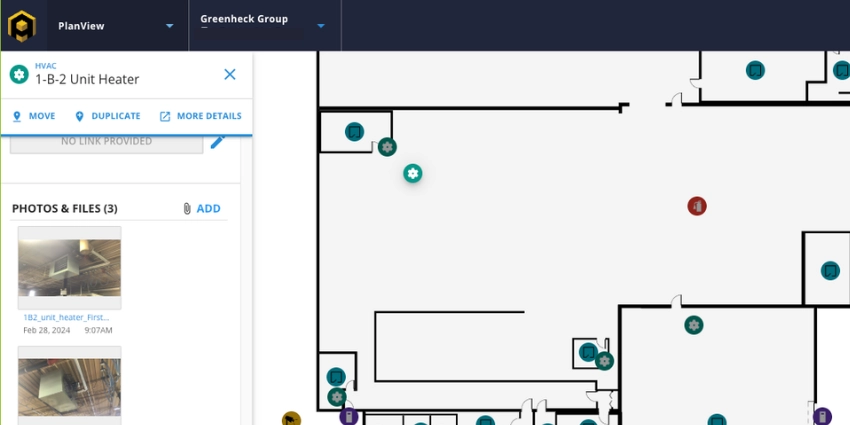
This is where Greenheck’s story gets particularly interesting. Rather than hiring an outside firm, Ozolins was tasked with conducting the FCA internally, and he chose AkitaBox Capture to do so.
Campus operations staff assessed their own buildings. Jackan personally assessed the satellite locations. And they got creative with vendor time: during routine preventive maintenance visits, Greenheck’s mechanical contractor assessed HVAC equipment, and their overhead door company captured condition data on doors and dock equipment — all entered directly into AkitaBox.
The team focused on five core asset categories — HVAC, parking lots, overhead doors, dock equipment, and roofing — and now maintains a living assessment that updates continuously rather than aging on a shelf.
Ozolins notes the team has barely scratched the surface: “We’ve probably used 10% of what it can do, but the initial rollout was very simple to use.”
The Results: Proactive Budgeting, Backed by Data
The FCA immediately changed how Greenheck approaches capital planning. Assets rated “failed” or “very poor” rise to the top of the next fiscal year’s budget. And when emergencies arise or equipment failure is predicted, they’ve got the data to back their strategy.
One example of this is when a 25-year-old air handling unit serving 90 office employees in Minneapolis started showing consistent issues, Jackan used AkitaBox’s condition history to build the case for proactive replacement — a roughly $500,000 investment. In the middle of a Wisconsin summer, waiting for catastrophic failure wasn’t an option.
“Through using AkitaBox and having that history of knowing this unit has had a history, and it’s on its last legs… we were able to help sell a half a million dollar replacement,” Jackan says.
The Impact of Proactive Asset Management in AkitaBox
- ~10,000 preventive maintenance tasks now tracked in AkitaBox (previously managed on paper and spreadsheets
- Ability to pull instant reports by asset, building, or campus – facilities-specific reporting that wasn’t possible in their old syste
- Capital planning shifted from blanket estimates to asset-level budget justification, with condition ratings automatically surfacing what needs funding next
- Email relay workflow eliminated — vendors manage work orders directly in-platform
- 30-second service requests — the portal link lives on SharePoint and adoption required no formal rollout
- Portfolio agility — four new buildings are being onboarded within months across three cities
“Our company motto is ‘easy to do business with.’ I think this helps make us more efficient in order to obtain that.”
Kent Ozolins • Facilities Project Manager
Looking Ahead
Greenheck plans to expand their FCA to additional asset categories and begin tagging work orders to specific assets for deeper lifecycle reporting. With their newest campus in Knoxville adding up to 12 buildings — the portfolio will only continue to grow.
Jackan has become an advocate in the local facilities community, recommending AkitaBox to peers at IFMA events. A local user community is forming with other Wisconsin organizations.
“Our company motto is ‘easy to do business with.’ I think this helps make us more efficient in order to obtain that.” says Ozolins.