
Why AEC Firms Keep Trying (and Failing) to Build Their Own FCA Tool
If your firm does assessments, you may recognize this process: assessors go on-site with the guidance of a paper floor plan, make hand notes, snap photos on their phones, come back to the office, and copy-paste everything into Excel. Someone on the assessment team says it out loud: “It’s just so inefficient.” So someone mentions creating their own app with the in-house coder. A few meetings happen. And then it stalls, because there’s always a gap between what the tool needs to do and what the coder understands about the problem.
Months pass. The coder builds something that sort of works for part of the workflow but misses everything else. Eventually someone Googles “FCA software” and finds out the tool they’ve been trying to build already exists.
We hear this pattern on nearly every intro call.
Why an In-House FCA App Stalls
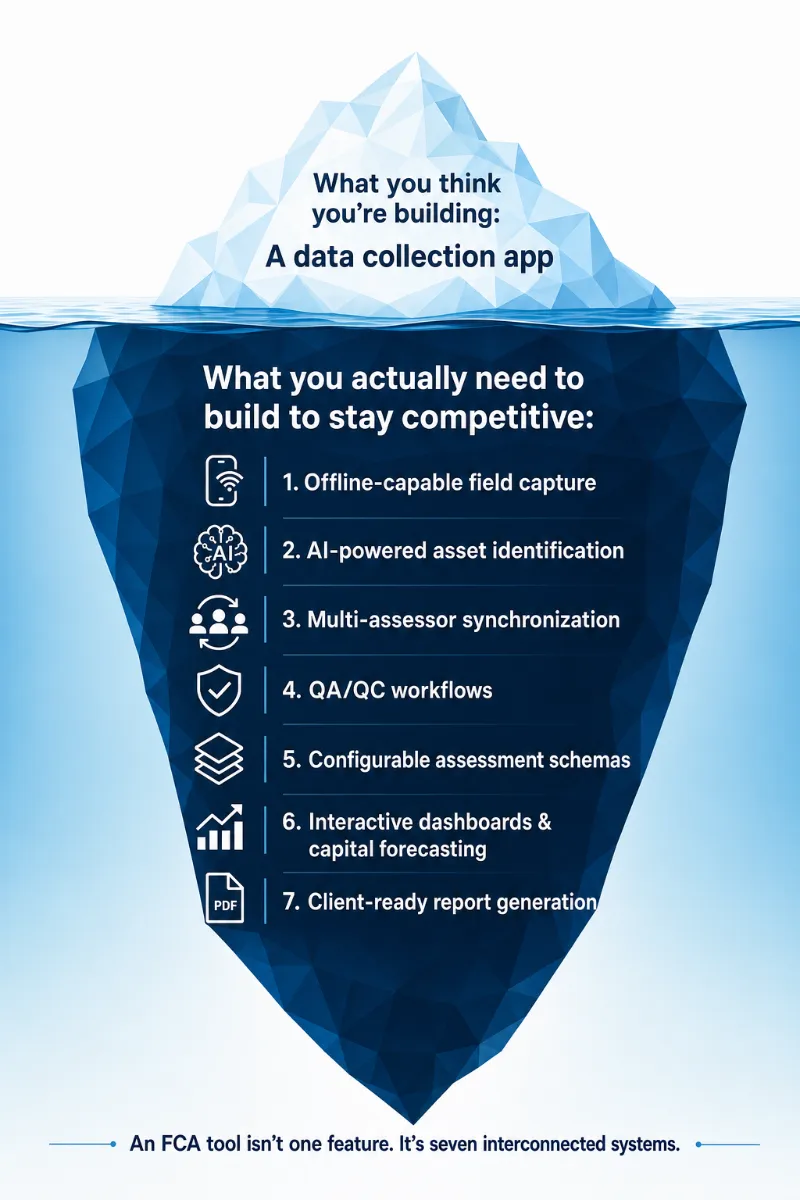
The gap between design professional and coder isn’t a communication problem. It’s a scope problem. What looks like one tool is actually seven:
- Offline-capable field capture: your assessors aren’t always connected, and the tool needs to work anyway.
- AI-powered asset identification: snap a photo of a nameplate and extract make, model, serial number, tonnage, and hidden metadata on the fly.
- Multi-assessor synchronization: four people in the field, one dataset, zero conflicts.
- QA/QC workflows: someone back at the office needs to review, flag, and approve before anything goes to the client.
- Configurable assessment schemas: Ohio’s 23-point system today, UniFormat level 5 tomorrow, CSI next month, custom the month after that.
- Interactive dashboards and capital forecasting: not a static Excel chart, but a BI tool that slices FCI scores, replacement cost, and mission impact on the fly.
- Client-ready report generation: Deliverables that don’t require 40 hours of formatting (but can still be exported to PDF if required).
Your in-house coder might nail one of these. Maybe two. But an FCA tool isn’t a single feature, it’s an interconnected system where field data flows into dashboards, dashboards feed reports, and reports need to reflect whatever schema the client requires. The moment you solve capture, you realize you haven’t touched output. The moment you solve output, you realize QA is a mess.
And the whole time, your coder’s actual job, the thing you hired them for, isn’t getting done.
"But What About AI Coding Tools?"
Fair question. Cursor, Copilot, Claude, these tools genuinely lower the barrier to building software. So doesn’t that change the math?
Not the way you’d think. Here’s why:
AI helps everyone build faster, including dedicated product teams that started with a decade of domain knowledge, existing infrastructure, and full-time engineers. The multiplier works in their favor too. Your coder’s weekend prototype isn’t closing the gap. It’s falling further behind.
The app isn’t the hard part. The data architecture is. You can vibe-code a form that collects asset data in a weekend. You cannot vibe-code a database structure that lets AI crawl freely across asset hierarchies, extract serial number metadata, decode manufacturer specs on the fly, and generate schemas from a client’s problem description. That kind of architecture comes from years of domain-specific decisions.
Version 1 ships. Version 2 doesn’t. AI makes it easier than ever to get a prototype out the door. It does not make it easier to maintain that prototype while your firm is actively assessing hundreds of buildings a year. The in-house tool freezes at whatever version you shipped, because no one has time to iterate. A purpose-built platform ships new enhancements every few months — cool things that make the product more efficient while your in-house build is still sitting at the line established last year. The maintenance burden doesn’t disappear just because AI wrote the first draft.
The Math on House Built vs Purpose-Built FCA Platform
Let’s be blunt about timelines:
In-House Build |
Purpose-Built Platform |
|
| Time to basic capture | 4–8 weeks | 1–2 weeks (onboarding) |
| Time to full workflow (capture → QA → dashboards → reports) | 6–18 months (if ever) | Day one |
| Who maintains it | Your team, forever | The platform team |
| Self-sufficient operation | Unknown | ~6 months |
The RFP Pressure
A few years ago, RFPs started changing. They began calling out electronic data collection methodology specifically, asking firms to explain how they’d capture, store, and deliver assessment data digitally.
This isn’t a nice-to-have anymore. If your answer to “How will you collect this data electronically?” is “We’re building something,” you’re losing to firms that can demo a working system in the proposal meeting.

What "Buying" FCA Software Actually Looks Like
The word “buying” makes AEC firms nervous because it sounds like giving up control. It’s not. Here’s what it actually means when you buy from a full FCA software platform like AkitaBox:
- Keep your methodology. The platform is configurable, your schema, your scoring, your process. Not ours forced onto you.
- Work with whatever floor plans you have. Paper, CAD, PDF, napkin sketch. The system doesn’t require perfect inputs.
- Unlimited clients, unlimited properties. You’re not paying per building or per owner. Scale without math.
- Self-sufficient in 6 months. You’re not dependent on us to run assessments. You learn the system, you own the workflow.
- AI field assistant. It prompts assessors for missing schema fields, decodes nameplates, and fills gaps in real time.
- Resell to your clients. The platform becomes a sticky, recurring revenue service you offer, capital planning dashboards, ongoing updates, the whole lifecycle. Not just a one-time PDF hand-off.
Stop Vibe Coding. Start Delivering.
The meeting where someone says “there’s got to be something out there,” that’s the meeting that matters. Everything before it is an expensive lesson. Everything after it is momentum.
Your firm wasn’t built to develop software. It was built to assess buildings, advise clients, and win work. A purpose-built FCA platform lets you do more of that and less of of the tedious manual work that holds back your firm.
See how AEC firms onboard quickly to AkitaBox FCA Software →