
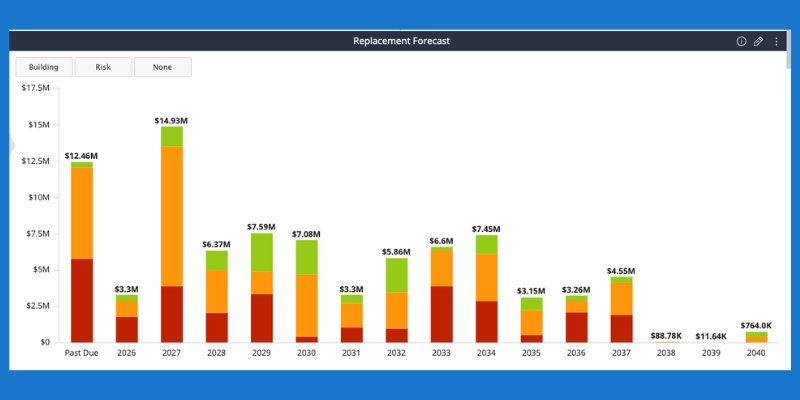
Every facility condition assessment ends the same way: a spreadsheet or dashboard of deferred maintenance, broken out by year. It’s the deliverable owners pay for, and on paper it looks like a plan. 12.5 million dollars in deferred work — a million due next year, seven million the year after, two million the year after that.
The problem is, it isn’t a plan. It’s a forecast — and boards don’t fund forecasts.
The Gap Between "What's Needed" and "What's Fundable"
CEOs and boards think in predictable numbers. A capital budget gets set every couple of years, usually as a flat or slightly variable annual figure, and it stays roughly flat year over year because that’s how capital planning works everywhere outside of facilities: you fund a program, not a spike. Nobody walks into a board meeting and asks for $1M this year, $7M next year, $2M the year after. That request gets sent back for “smoothing” before it’s even discussed.
So the FCA forecast — accurate as it is — collides with how capital actually gets approved. The result is a familiar cycle: the assessment gets shelved, urgent failures get funded reactively, and next year’s assessment shows the same backlog, a little worse.
The missing piece isn’t better data. It’s a way to ask the question capital committees will ask: “If we commit to spending $4M a year, every year, what happens to the backlog — and which of our priority projects get done, and when?”
Turning a Forecast into a Scenario
That’s a different kind of tool than a forecast report. It needs to take the same underlying FCA data — cost, due date, condition, priority — and run it forward under a funding constraint instead of just reporting the constraint-free need.
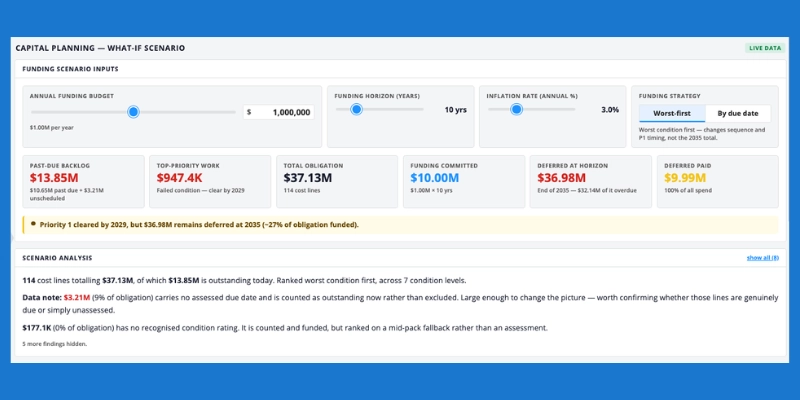
A few things have to be true for that model to be trustworthy rather than just optimistic:
- It has to fund in priority order, not due-date order.** A flat budget will always fall short of total need in some years, so the model has to make the same triage decision a facilities team would — worst condition first — and be transparent about what gets pushed.
- Unspent budget has to roll forward.** A model that lets leftover money vanish in a light year understates how fast a flat budget clears backlog.
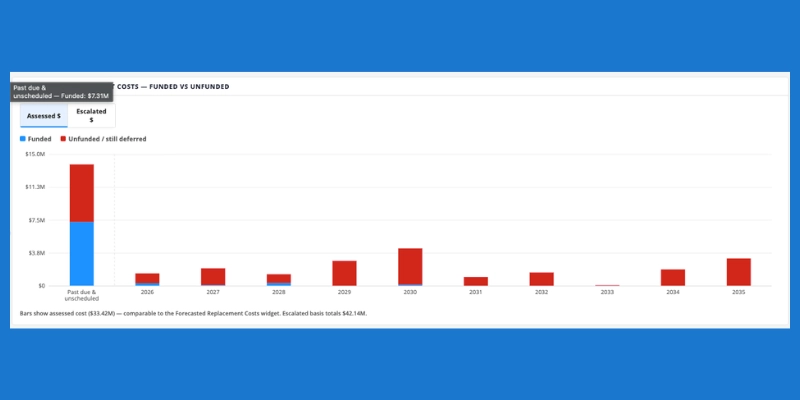
- It has to show what stays deferred, not just what gets spent.
** The number that matters to a board isn’t the check they wrote — it’s the backlog still standing at the end of the horizon, and how that number moves (or doesn’t) as the annual budget moves.
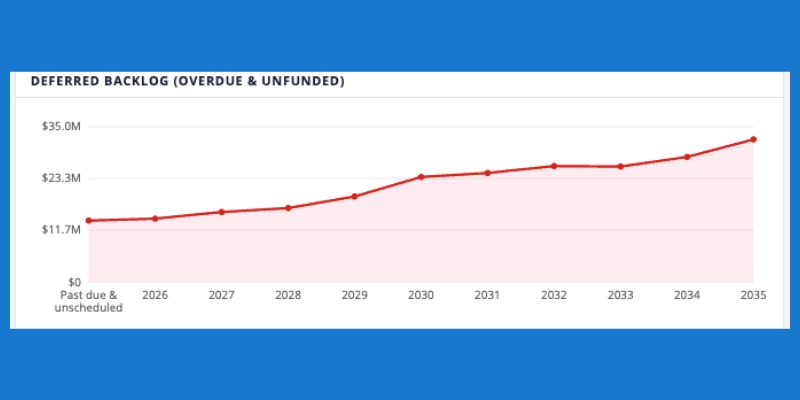
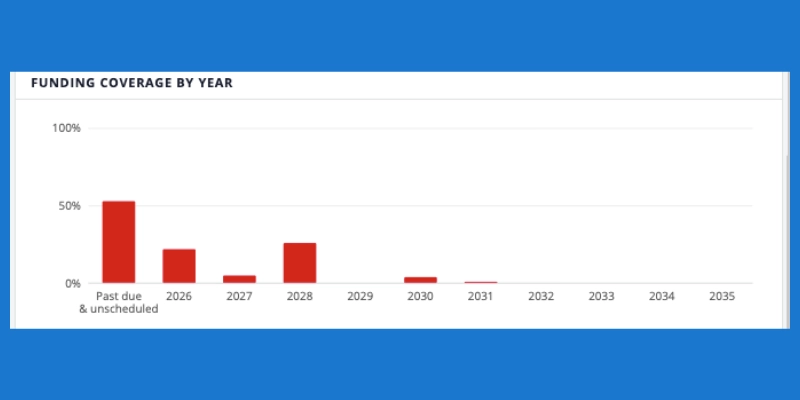
Run that model against a real portfolio and the conversation changes shape. Instead of “we need $19.5M by 2035,” the conversation becomes “at $4M a year, our worst-condition assets clear by year three, and $X in backlog remains at year 10 — here’s what it takes to close that gap instead.” One of those is a number a board can act on. The other is a number a board tables. This is why this has to live with the assessment data, not next to it.
It’s tempting to treat this as a spreadsheet exercise — export the forecast, model scenarios offline, bring back a slide. That works once. It doesn’t survive a portfolio that gets reassessed, a budget that gets revised mid-year, or a board that wants to see three funding levels side by side in the same meeting.
A scenario model that’s wired directly to live FCA data — same cost lines, same condition ratings, same due dates the assessment already produced — stays current automatically and lets a team answer immediately for the question “what if we cut the budget 20%?”, instead of in a follow-up email two weeks later.
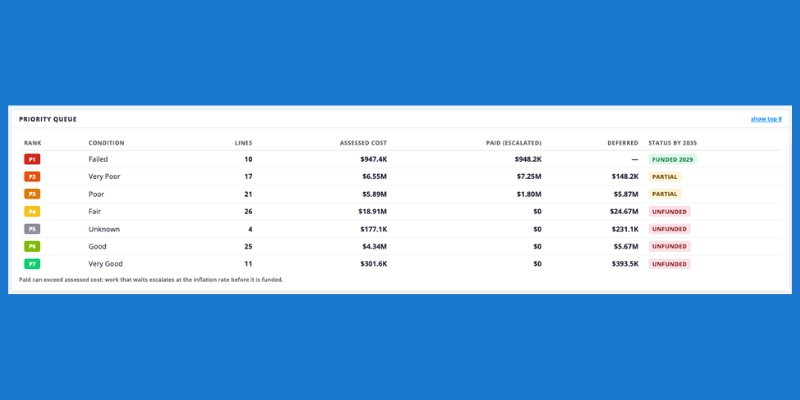
That’s the real value-add: not a better forecast, but a bridge between what a facility needs and what an organization is truly willing to approve — built on the assessment data that already exists, instead of a parallel spreadsheet someone has to maintain by hand.
The forecast tells you the size of the problem. The scenario model is what lets you plan around it.
AkitaBox Capital Management lets you run funding scenarios directly against your live FCA data — priority-ordered, with rollover budgets and real visibility into what stays deferred. No parallel spreadsheets required. [See how it works →]