
Give Your Clients an FCA They’ll Actually Keep Using
The Living FCA, and why winning AEC firms are embracing it
Building owners are getting smarter about what they want from a facility condition assessment. More and more RFPs now require FCA results delivered digitally, not as a static PDF that’ll collect dust on a shelf, but as living data they can actually use. If your firm isn’t set up to deliver that, you’re already out of the running for a growing number of projects.
The message is clear: the FCA game is changing, and there’s a real opportunity here for firms willing to evolve.
The Problem with Traditional FCAs (Yes, We Still Need to Talk About It)
Look, we get it. Plenty of firms still do FCAs the old-fashioned way: clipboards, spreadsheets, PDFs. It works. Sort of. But here’s the thing: those traditional FCAs are static snapshots of a facility at one moment in time. They’re basically outdated by the time you hit “print.” The facility keeps changing, but the report doesn’t.
One engineering partner of ours tells a story that captures the problem perfectly. During a visit to a client facility, he discovered a binder containing a report he had written years earlier, sitting untouched exactly where he’d left it. Comprehensive reports are being created but rarely fully utilized. The information is valuable, but its presentation makes it inaccessible to the people who need it most.
Traditional static FCAs tend to be one-time-use, not additive, wasteful, and offer no comparative analysis. They’re created, delivered, and eventually tossed out and completely redone a few years later.
When everyone delivers the same kind of FCA in the same kind of format, clients make decisions based on price. The cheapest option wins. That’s not a great position to be in.
Enter the Living FCA
So what exactly is a Living FCA? Let’s define it:
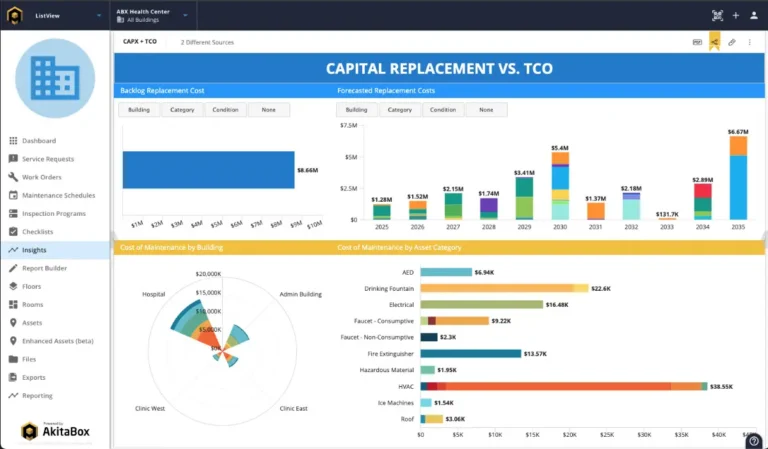
A Living FCA is a facility condition assessment delivered through software that makes all the data easy to collect, navigate, understand, and act on. Unlike traditional static reports, a Living FCA can be continually updated over time, keeping it in sync with the actual condition of the facility.
Think of it this way: instead of handing your client a binder that becomes a paperweight, you’re giving them a tool. A tool they can use to track changes, plan maintenance, allocate capital, and make smarter decisions year after year.

With a Living FCA:
The data stays current. Add maintenance records, inspection results, and condition updates long after the initial assessment is complete.
- Capital planning gets smarter. Built-in cost data and AI-assisted costing let you generate defensible budget requests backed by line-by-line detail. No more guessing or gut decisions. Accurate, up-to-the-minute data drives your budget and lets you track Facility Condition Index (FCI) across your portfolio.
- Trends become visible. Compare historical data against current conditions to spot patterns and predict problems.
- Preventive maintenance improves. Knowing the real-time condition of every asset helps you adjust PM efforts to each asset’s unique needs.

Why Building Owners Are Demanding Digital FCAs
Here’s what’s driving this shift to Living FCAs: building owners and facility managers don’t have time to dig through three-ring binders. They want information at their fingertips, accessible, searchable, and actionable.
More importantly, building owners are recognizing that a one-time assessment shouldn’t be a one-time relationship. They want partners who can help them manage their facilities data over time, not just hand off a report and disappear for half a decade.
If your firm can deliver an FCA that evolves with the building, one that becomes more valuable over time rather than less, you’re offering something fundamentally different from everyone else. You’re not competing on price anymore. You’re competing on value.
What Makes a Living FCA Different
A Living FCA delivered through modern FCA software provides advantages that static reports simply can’t match:
Faster Completion
With nothing more than a mobile device, your engineer or field tech can drop a pin on a digital floor plan, snap photos, and upload data directly into the system. No more coming back to the office with 1,000 photos on a phone and spending a week building a report. Digital data collection also reduces the error-prone manual entry that slows traditional assessments down. AI-assisted capture can automatically extract asset information from equipment nameplates, eliminating tedious manual data entry and standardizing the data structure. Your clients get results faster, and your team moves on to the next project sooner.
Living FCA in Practice with C & W Services
C&W Services, a global leader in facilities services, saw dramatic efficiency gains after adopting digital data collection tools in their asset inventory processes. Their teams went from collecting 35-40 assets per day with their previous homegrown tool to 70-75 assets per day, and project timelines that once took 2-3 months now take just 3-4 weeks. (Read the C&W Services case study →)

Better, More Accessible Reports
All that condition data is digitized, tagged, and organized. Searching and sorting is instant. Clients can find whatever they need without flipping through pages.
The visual presentation changes the game entirely. Charts and graphs make deficiencies obvious at a glance, bridging the gap between engineers who speak in technical terms and decision-makers who need to understand business impact. When everyone from the facilities team to the CFO can interpret the same data, action happens faster.
Locational Intelligence
Every asset is mapped to digital floor plans. Your engineers can quickly locate assets during future assessments, and clients can pinpoint problem areas and visualize exactly what your team saw during the walkthrough. You can even layer multiple views, such as MEP systems, safety infrastructure, or phased renovation plans, so teams can toggle exactly what they need to see.
Ongoing Value
This is the big one. A digital FCA allows clients to keep adding data in the weeks, months, and years after the initial assessment. It’s not a “see you in five years” situation. It’s the start of an ongoing relationship.
And as clients move toward digital twin initiatives, a Living FCA provides the foundation to get there faster.
Living FCA in Practice with MPO-Matador Joint Venture
Engineering firms using digital FCA platforms report that delivering a living deliverable opens doors to recurring engagements and long-term partnerships that simply weren’t possible with static reports. (Read the MPO-Matador case study →

The Living FCA Business Case for Your Firm
What does this shift mean for AEC firms in practical terms?
If a building owner requires a digital deliverable and you can’t provide one, you’re not in the conversation. Digital FCA capabilities expand the universe of projects you can bid on.
Static reports create transactional relationships. Living FCAs create ongoing partnerships. Clients who use a data platform for facility management are clients who come back for additional services.
And when your deliverable offers capabilities that competitors can’t match, you stop competing on cost alone.
Ready to Learn More About Living FCAs and the Value to Your Firm?
Building owners are asking for Living FCAs. The firms that can deliver them are pulling ahead, winning projects their competitors can’t even bid on and building long-term client relationships instead of transactional ones.