
3 Questions to Ask Before Buying AI-Powered Facility Management Software
After years of hype, we’re seeing AI tools that genuinely change how FM teams capture data, maintain assets, and make decisions. The challenge now isn’t whether AI can help—it’s knowing which solutions will actually deliver.
At Facility Fusion recently, someone stopped by our booth and shared their experience with their CMMS provider’s new AI feature. It summarizes work orders. That’s the whole feature. When asked what value it brought them, they just shrugged.
Here’s the good news: that’s not what AI in FM has to look like. The technology has matured to the point where it can do far more than condense paragraphs. The best implementations are helping teams build better data, stay ahead of equipment failures, and finally break the cycle of stale information.
The trick is knowing what to look for. Here are three questions that will help you find the solutions worth your time.
Question 1: Does your AI actually write data, or is it just a Q&A tool?

This is where the real opportunity lies.
Most AI chatbots do one thing: take the data you already have and try to make sense of it. Answer questions, summarize maintenance history, generate a report. That’s valuable, but only if your data is solid to begin with.
A chatbot is only as good as the data set it’s looking at. If you have a bunch of empty slots and incomplete records, your summaries are going to be terrible. You’re not going to get the information you need.
We all know the state of most FM data sets. There are pockets of excellence—maybe the high-value HVAC equipment is well-documented—but plenty of gaps elsewhere. The exciting development is that AI can now help close those gaps.
Native AI—AI built directly into the workflows where your team operates—doesn’t just analyze data. It helps you create better data in the first place. When you’re adding an asset, it suggests fields you might be missing. When you’re doing inspections, it flags incomplete records. It’s like having a knowledgeable colleague looking over your shoulder, catching things before they become problems.
The question to ask: “When I’m creating or updating records in your system, does the AI help me fill in data, or does it only help me query data that already exists?”
The best tools do both, and that’s where the real efficiency gains start to compound.

Question 2: Is your AI trained with boundaries?

Here’s a fun way to test this: ask the AI to make you a sandwich.
If it gives you a recipe, that tells you something important. General-purpose AI tools like ChatGPT or Gemini are designed to answer anything, which means they’ll try to answer anything—even when they shouldn’t. In facilities, that can lead to confident-sounding responses that are way off base.
The better approach is AI that’s been trained by experts to stay in its lane. It knows the FM space, the energy space, the building cost data world. It’s been taught what matters in facilities and what doesn’t. When you ask it something outside its expertise, it’s honest about its limits instead of guessing.
Here’s a cautionary tale: a major restaurant chain launched a chatbot for online ordering. Customers could describe what they wanted in natural language. But the AI had no boundaries. People quickly figured out they could ask it anything: how to fix their computer, questions about company operations, you name it. The chain had to pull it down.
The lesson isn’t that AI is risky—it’s that well-trained AI is dramatically more useful. When the boundaries are right, you get accurate, relevant responses instead of noise.
The question to ask: “What boundaries does your AI have? What happens if I ask it something outside of facility management?”
A vendor who’s done the work will have a clear, confident answer.
Question 3: Can this AI help us move toward predictive insights?
This is where things get exciting.
Getting to clean, accurate data is the foundation. But the real potential of AI in facilities is the ability to see problems coming before they become emergencies. That means AI has the potential to actively query your clean data in the background, spotting patterns, and surfacing insights without waiting for someone to ask.
Here’s what that looks like in practice: Imagine you have five identical air handling units, all tracking energy usage through your BAS. Four are running within normal parameters. One suddenly spikes 15% with no change in weather or occupancy.
A human probably won’t catch that—not because they’re not capable, but because reviewing energy data across multiple units on a regular basis just isn’t realistic for most teams. There’s too much else going on.
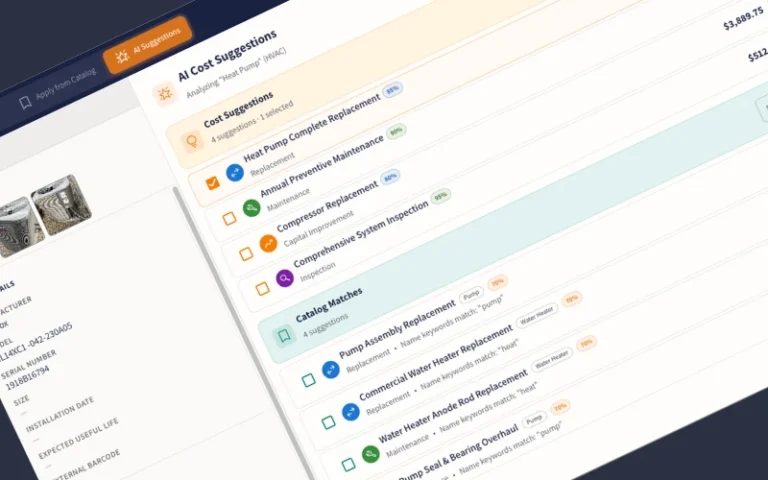
But AI can do exactly that. It sits in the background, watches for anomalies, and when it spots one, it doesn’t just send an alert—it creates a diagnostic work order and gets a technician dispatched. Before the unit fails. Before anyone’s weekend gets ruined.
Every time I log in to a tool, AI should be suggesting things. It’s monitoring things in the background. It knows patterns. A native trained AI can sit in the background and do those things for you.
This is the shift from reactive to proactive. It’s the difference between a static FCA that starts aging the moment it’s delivered and living data that evolves with your buildings.
The question to ask: “Does your AI proactively surface issues and recommendations, or does it only respond when I ask it something?”
The proactive stuff is where the real value lives.
The Bottom Line on Reviewing AI-Enabled Software and Apps for Facilities
AI in facility management has reached a turning point. The tools that are emerging now can genuinely help teams work smarter—not by replacing expertise, but by amplifying it. The key is finding solutions that go beyond surface-level features.
Three questions will get you most of the way there:
- Does it write data, or just read it?
- Is it trained with clear boundaries?
- Is it proactive, or just reactive?
When a vendor can answer these with specifics and show you how it works in practice, you’re looking at something worth your time. The potential is real—and the teams that find the right tools are going to pull ahead.