Is Poor Asset Data Hampering Your CMMS and AI Goals?
Why a trusted asset register comes before any new platform
If your organization has cycled through more than one CMMS, you are not alone. Industry estimates suggest that somewhere between 50% and 80% of CMMS implementations fail to meet their objectives.
The pattern is familiar: paper to spreadsheets to work-order system to enterprise platform, with each migration promising better visibility and each one risking lost data, context, or both.
But blaming the software misses the point. A new system does not fix unclear objectives, poor change management, bad underlying data, or a team that does not have the capacity to implement it well. If the foundation is shaky, the next platform will wobble the same way.
The Gap Almost Every CMMS Shares
A CMMS is built to manage work. It is not built to establish truth.
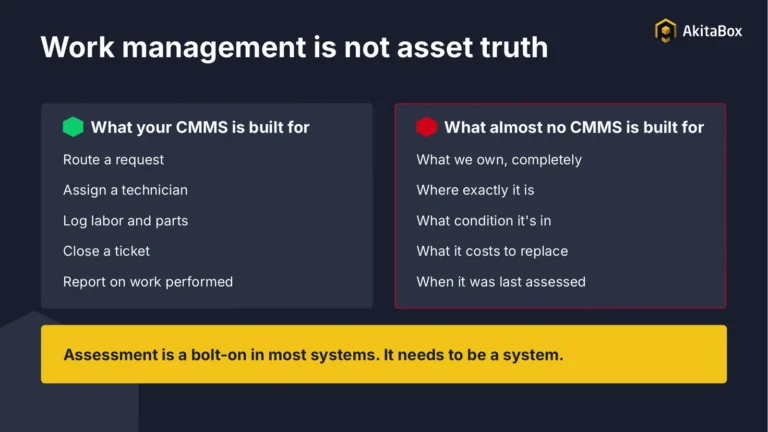
Work-order systems are designed to record, route, and close tasks. They do that well. What they are not designed to do is serve as a dedicated asset register or assessment platform. That means several things tend to go sideways:
- Incomplete asset registers. Equipment exists in the building but not in the system, or it exists in the system but no longer in the building.
- Ambiguous locations. An asset’s location is stored as a text field — “second floor mechanical room” — instead of a point on a verified floor plan. A real example: 225 unlabeled rooftop units across a 500,000-square-foot facility were numbered 1 through 225 with no way to tell which unit was which from the ground.
- Misattributed history. Work orders and costs get attached to a generic entry or the wrong record.
- Stale condition data. A condition score captured three years ago still looks current because nothing in the system flags it as aging. Decisions get made on assumptions.
And institutional knowledge makes this fragile in a way that doesn’t show up on a dashboard. When the senior tech who “just knows” where every unit is and what it needs walks out the door, that knowledge walks out with them. If it was never systematized, it’s gone.
Why the FM Data Problem Is Suddenly Urgent: AI Arrived
Predictive maintenance, automated diagnostics, and AI-driven capital planning all depend on one thing: clean, complete, well-structured asset data. Make, model, serial number, installation date, condition, location, and correctly attributed failure and cost history. These are assessment outputs, not work-order outputs.
Without that foundation, AI does not give you better answers. It gives you bad answers faster. Teams lose confidence in the tool, revert to gut decisions, and the investment is wasted.
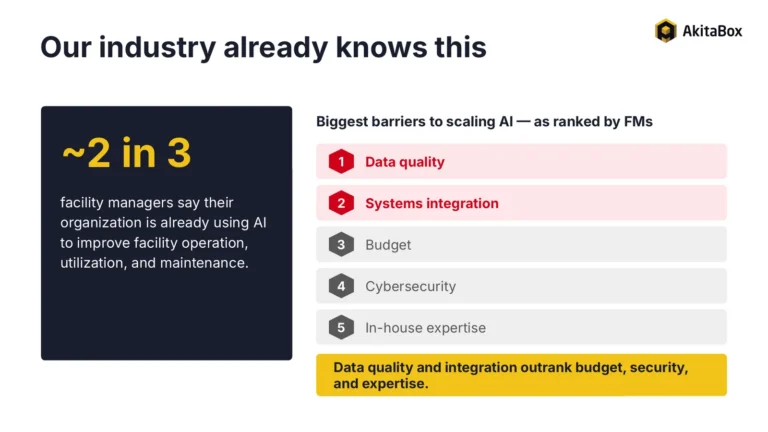
Johnson Controls’ 2026 survey found that while roughly 67% of FM teams already use AI in some form, data quality and integration remain the leading barrier to scaling — cited more often than even budget constraints (Johnson Controls).
The bottleneck is not the algorithm. It is the asset data underneath it.
What FM Capital Planning Looks Like Without Good Data
While operations teams wrestle with data quality, the financial pressure is compounding. Buildings are more complex than they used to be, hidden systems are everywhere, and the stakeholders holding the purse strings increasingly want evidence — not estimates — before they approve capital spend.
The 2025 State of Our Schools report found an annual PK–12 facilities funding gap of approximately $90 billion (2025 State of Our Schools). Moody’s estimates that roughly 500 rated higher-education institutions face nearly $1 trillion in capital needs over the next decade (Moody’s / Higher Ed Dive).
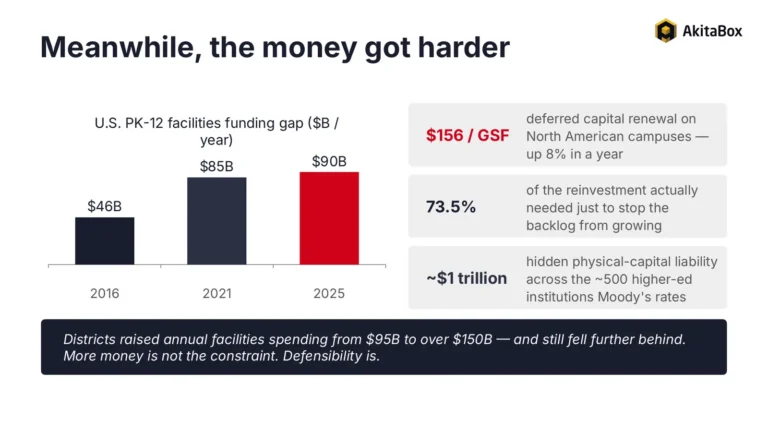
Defending a share of that money requires asset-level condition, cost, risk, and maintenance data — all tied to a common, trustworthy record. A spreadsheet assembled once every five years does not hold up when leadership asks follow-up questions. Neither does a CMMS export full of text-field locations and orphaned work orders.
Budget defense has become a data problem. And the organizations that can show the mapped asset, the photos, the condition score, the risk profile, the cost history, and the backlog rationale are the ones getting funded.
What Solving the Asset Data Gap Actually Looks Like
None of this requires replacing your CMMS. It requires building a trusted asset-information layer that your CMMS — and every other system — can draw from. AkitaBox exists to own exactly that layer.
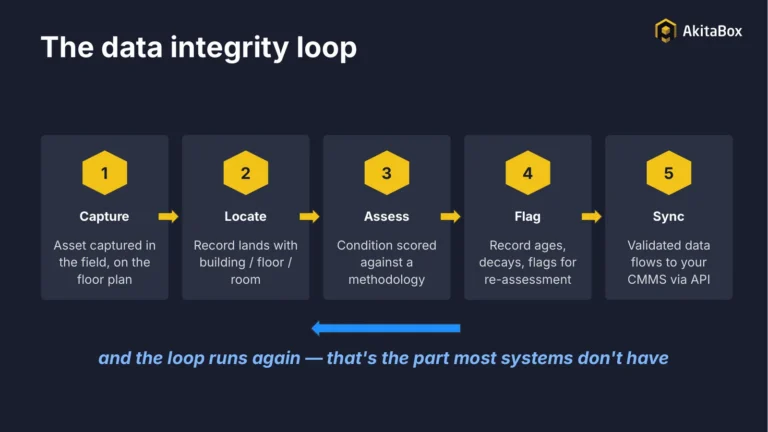
1. Every asset lives on a floor plan, not in a text field.
Assets are pinned to verified floor plans, so “second floor mechanical room” becomes an actual, clickable location. When a tech gets a work order, they know exactly where to go — no radio calls, no guessing, no wandering.
2. Assessment is a system, not a one-time project.
Instead of a consulting engagement that produces a static report every five years, assessment becomes an ongoing, managed process. Data is captured in a structured format that updates over time, so condition scores and asset inventories stay current. A major reassessment may still happen on a cycle, but you are not flying blind between them.
3. Upkeep is built into routine work.
Condition checks, photos, and observations can be folded into existing PM workflows. The people already visiting the equipment become the eyes and ears of the assessment program — no separate crew, no separate trip. The assessment stays evergreen because it is woven into operations.
4. Open API: your CMMS gets better, not replaced.
AkitaBox integrates with existing CMMS platforms through an open API. The asset register becomes a shared foundation rather than a silo. When the next CMMS migration inevitably comes, the asset data layer stays intact — reducing lock-in and making the switch less disruptive.
5. Numbers that hold up in a budget hearing.
With asset-level condition data, replacement costs, risk and criticality scores, and properly attributed maintenance history all tied to a mapped location, capital requests stop being educated guesses. They become defensible, auditable cases backed by a system of record.
Your CMMS Isn’t the Problem — Your Asset Data Is
Your organization probably does not need another CMMS. It needs a trusted asset register — one that gives every system, every stakeholder, and eventually every algorithm a single source of truth about what you own, where it is, and what shape it is in.
The question is whether the asset data underneath your operation is ready for what you are asking it to support.
For a deeper look at why asset data quality is the linchpin for AI, capital planning, and day-to-day operations, check out the companion white paper with IFMA and the on-demand webinar that digs into real-world examples and practitioner Q&A.